
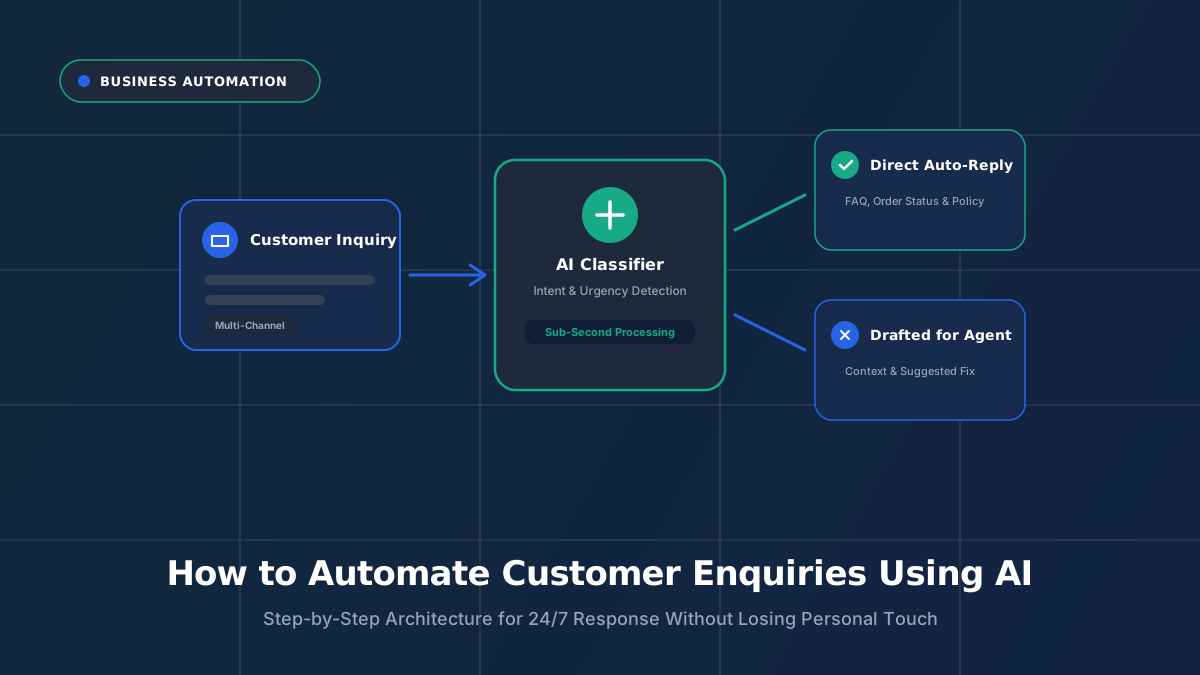
For most growing businesses, customer communication follows a consistent pattern: a substantial proportion of inbound inquiries revolve around a small set of recurring operational questions—order shipping status, return procedures, operating hours, pricing structures, and basic troubleshooting.
Handling every routine inquiry manually consumes significant staff capacity. However, deploying an unregulated AI responder without proper safety guardrails risks factual errors, customer frustration, and brand damage.
A robust customer automation architecture relies on four modular stages: consolidation, deterministic triage, grounded retrieval, and human-in-the-loop review.
Stage 1: Inbound Webhook & Channel Consolidation
Before applying artificial intelligence, all inbound communication streams must be unified into a single structured pipeline:
- Website contact forms and live chat widgets
- Support email accounts (e.g.,
help@yourbusiness.com) - E-commerce storefront message queues (Shopify, WooCommerce)
Using standard integration platforms (such as Zapier, Make, or native helpdesk webhooks in Zendesk, Freshdesk, or Gorgias), every inquiry is normalized into a standard structured payload:
{
  "customer_id": "cust_84920",
  "channel": "email",
  "inbound_text": "I ordered three days ago but have not received a tracking link yet.",
  "timestamp": "2026-11-01T14:22:00Z"
}
Stage 2: Intent Classification & Sentiment Analysis
Rather than immediately generating an automated response, the incoming text passes through a compact classification model:
{
  "intent": "order_tracking_inquiry",
  "urgency": "medium",
  "sentiment": "neutral",
  "contains_dispute": false,
  "requires_human_escalation": false
}
Essential Safety Rules at Classification:
1. Dispute & Legal Isolation: Any message exhibiting high dissatisfaction, chargeback threats, or regulatory disputes is immediately routed to human management with high-priority flagging. 2. Account Security Protection: Requests to modify shipping addresses or payment methods after order placement must trigger manual identity verification to protect against account takeover fraud. 3. Data Protection Compliance: Under GDPR (UK/EU) and CCPA (US), customer personal data and payment credentials must never be passed to unvetted third-party language models without a signed Data Processing Agreement (DPA).Stage 3: Grounded Knowledge Retrieval (RAG)
The primary cause of failure in automated customer communication is hallucination—an AI model inventing return policies, quoting unauthorized discounts, or promising delivery dates that do not exist.
To prevent hallucinations:
- Strict Grounding: Restrict the response generation to verified internal documentation: your published Return Policy, Shipping Timelines, Pricing FAQ, and Product Documentation.
- Explicit Fallback Directive: Configure the model prompt with an uncompromising rule: "Answer the inquiry using only the provided store context. If the documentation does not contain the answer, output: [ESCALATE_TO_HUMAN]. Do not extrapolate or guess."
Stage 4: Guardrails & Human-in-the-Loop Review
The final stage determines whether an automated draft is dispatched directly or routed into an agent review queue:
1. High-Confidence Informational Responses: Routine, low-risk inquiries—such as store opening hours or links to the public order tracking portal—can be delivered automatically.
2. Medium-Risk Inquiries (Draft Assist Mode): For inquiries involving specific product compatibility or policy exceptions, the system drafts a polite proposed response in the agent inbox. The support representative reviews the draft, makes any necessary adjustments, and clicks Send. This typically reduces drafting time from several minutes to a quick review while ensuring 100% human accountability.
Operational Benchmarks & Quality Indicators
When evaluating automated customer support workflows, track verified operational metrics rather than marketing deflection promises:
- First Response Time (FRT): Measure the reduction in initial acknowledgment time across business and non-business hours.
- Escalation Accuracy: Track the percentage of complex inquiries correctly identified and routed to human staff without customer complaints.
- Customer Satisfaction (CSAT): Compare post-interaction satisfaction scores between fully automated, draft-assisted, and purely manual resolutions to ensure service quality remains high.